

Blog
How to Start a Workplace Drug Testing Program: 8-Step Checklist
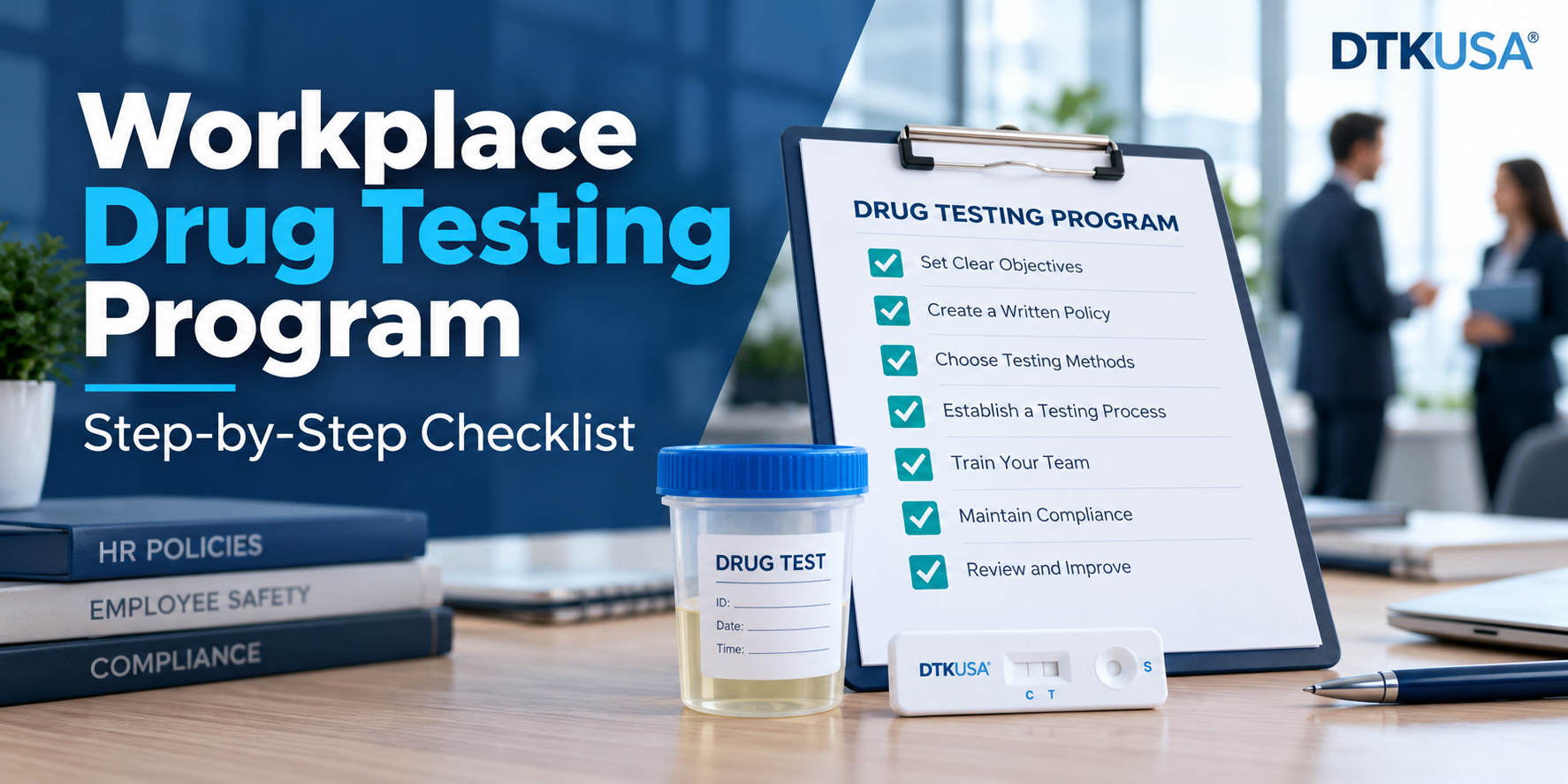
Maybe your insurance carrier asked about it. Maybe you had an incident on the floor. Or maybe you’re simply looking for a more consistent approach

DOT Drug Testing Requirements: What Employers Need to Know (2026 Guide)
Understanding DOT drug testing requirements is essential if you employ commercial drivers, pilots, transit operators, pipeline workers, or anyone else in a DOT safety-sensitive position. Unlike a company drug-testing policy, DOT testing is a federal compliance obligation with specific rules for collection, laboratory testing, review, reporting, and recordkeeping.
This guide explains the core requirements, the situations that trigger testing, and where rapid on-site drug tests do and do not fit into a workplace testing program.
DOT drug and alcohol testing is governed by two regulatory layers.
49 CFR Part 40 establishes the procedures used across federally regulated transportation industries. These procedures cover specimen collection, laboratory testing, Medical Review Officer review, reporting, and employee protections.
Each DOT agency then establishes its own rules defining which employees are covered and when testing is required. These agencies include:
Federal Motor Carrier Safety Administration (FMCSA)
Federal Aviation Administration (FAA)
Federal Railroad Administration (FRA)
Federal Transit Administration (FTA)
Pipeline and Hazardous Materials Safety Administration (PHMSA)
United States Coast Guard (USCG)
Employers must comply with both Part 40 and the regulations issued by the agency overseeing their industry.
DOT drug testing uses a federally standardized five-panel test. Employers cannot select a different panel or establish their own cutoff levels for DOT-required testing.
The DOT panel tests for:
Marijuana metabolites
Cocaine metabolites
Amphetamines, including methamphetamine, MDMA, and MDA
Opioids, including codeine, morphine, 6-acetylmorphine, hydrocodone, hydromorphone, oxycodone, and oxymorphone
Phencyclidine, commonly known as PCP
The testing panel, cutoff levels, collection procedures, and Federal Custody and Control Form are established by federal regulation. A company cannot substitute a different drug panel or testing method for a DOT-mandated test.
DOT agency regulations require testing in six primary circumstances.
A covered employee must receive a verified negative drug-test result before performing safety-sensitive duties.
Random testing must be unannounced and conducted throughout the calendar year. The applicable DOT agency establishes the minimum annual testing rate.
For FMCSA-regulated commercial drivers, the current minimum rates are 50% for controlled substances and 10% for alcohol. Employers should confirm current rates with the agency overseeing their industry because rates can change and may differ among DOT agencies.
Testing may be required following a qualifying accident. Employers must understand the criteria and testing timeframes established by their governing DOT agency.
An employee may be required to test when a trained supervisor documents specific observations associated with possible drug or alcohol use.
An employee who has violated a DOT drug or alcohol regulation must complete the required evaluation and treatment process before taking a return-to-duty test. The employee cannot resume safety-sensitive duties until the required process is completed and a negative result is received.
After returning to duty, the employee must complete a series of unannounced follow-up tests under a plan established by a qualified Substance Abuse Professional.
Failure to complete required testing or maintain the appropriate documentation can create serious compliance problems during a DOT or FMCSA review.
Rapid point-of-care drug tests, including cups, dip cards, and cassettes, cannot be used to satisfy a DOT-mandated drug-testing event.
DOT-compliant testing requires an approved specimen collection process using a Federal Custody and Control Form. The specimen must be sent to a laboratory certified under the applicable federal program. The laboratory performs the initial screening and confirms non-negative results using an approved confirmatory method.
Results are then reviewed by a qualified Medical Review Officer before being reported to the employer.
Instant drug tests, hair tests, blood tests, and other alternative testing methods cannot replace the federally required DOT testing process.
DOT regulations have authorized oral-fluid testing as an alternative collection method. However, employers must confirm that all federal implementation requirements are operational before using oral fluid for a DOT test. An instant saliva test does not qualify as a DOT-compliant oral-fluid test.
Many DOT-regulated companies also employ workers who do not perform DOT-covered, safety-sensitive duties. This may include office employees, warehouse personnel, administrative staff, and non-CDL drivers.
Employers can maintain a separate non-DOT drug-testing policy for these employees. Depending on applicable state and local laws, a non-DOT program may allow the employer to select its own:
Drug-testing panel
Testing circumstances
Cutoff levels
Specimen type
Screening method
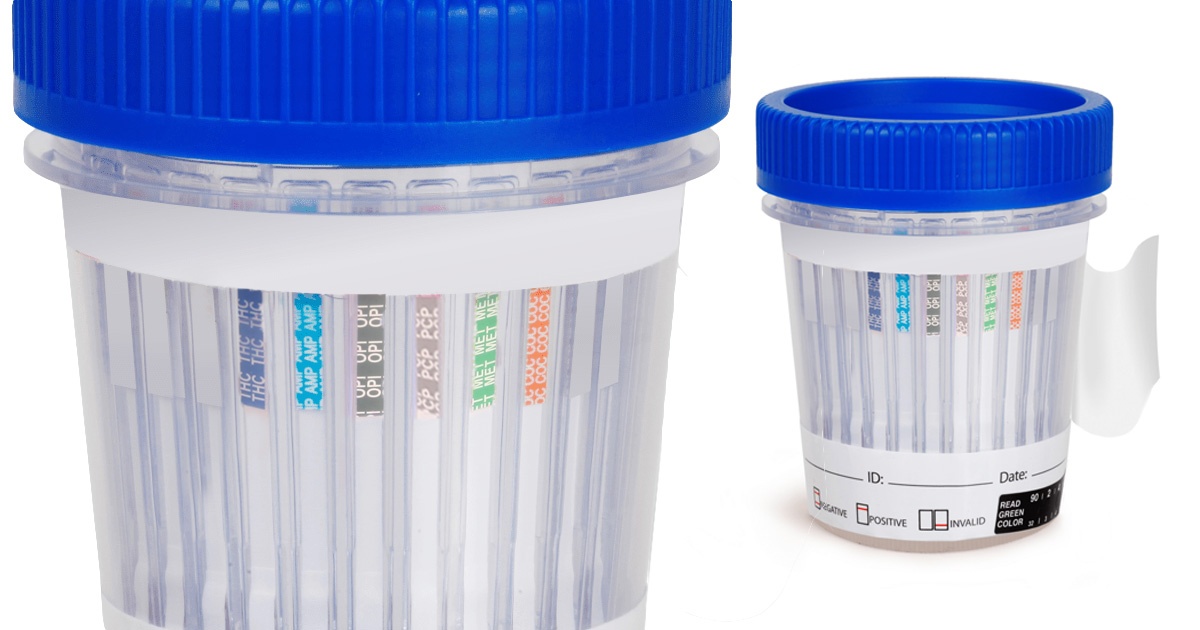
CLIA-waived drug test cups and dip cards can provide fast, convenient on-site screening for a properly established non-DOT workplace program.
The company’s written policy should clearly distinguish between DOT-covered employees and non-DOT employees. It should also explain which testing procedures apply to each group. Mixing DOT and non-DOT procedures within the same policy can create confusion and compliance risks.
Employers of FMCSA-regulated commercial drivers must query the FMCSA Drug and Alcohol Clearinghouse before allowing a driver to perform safety-sensitive duties. Employers must also conduct an annual query for each covered driver.
The Clearinghouse maintains information about drug and alcohol program violations involving drivers who hold commercial driver’s licenses or commercial learner’s permits.
Employers must retain testing, training, policy, and Clearinghouse records for the periods required by the applicable regulations. Retention requirements vary according to the type of record. Certain records, including verified positive results, must be kept longer than others.
Employers should confirm current requirements under 49 CFR Part 40, applicable agency regulations, and the FMCSA Clearinghouse rules.
Employers should verify that their program includes:
A written DOT drug and alcohol policy distributed to all covered employees
Procedures for all required testing categories
A properly managed random-testing pool
Current minimum annual random-testing rates
Approved specimen-collection procedures
Qualified collectors and Medical Review Officers
Federally certified laboratories for DOT-required drug testing
Supervisor reasonable-suspicion training
Required pre-employment and annual Clearinghouse queries for covered commercial drivers
Complete testing, training, and policy records
A separate policy for non-DOT employees, when applicable
No. Instant cups, dip cards, and other rapid drug tests cannot satisfy a DOT-mandated testing requirement. DOT testing must follow the federal collection, laboratory, review, and reporting process.
The federally standardized panel covers marijuana metabolites, cocaine metabolites, amphetamines, opioids, and PCP. The regulations also identify the specific substances and cutoff levels within these categories.
Random testing must occur throughout the year at the minimum annual rate established by the applicable DOT agency. Rates can vary by agency and may change, so employers should confirm the current rate for their industry.
Federal regulations authorize oral fluid as an alternative specimen type, but employers must verify that all federal implementation requirements are operational. An instant saliva drug test does not qualify as a DOT-compliant oral-fluid test.
DOT testing is governed by federal regulations that determine who must be tested, when testing occurs, and which procedures must be followed. A non-DOT program is created by the employer and is generally more flexible, subject to applicable federal, state, and local employment laws.
DOT drug testing leaves little room for employers to create their own procedures. The testing circumstances, specimen-collection process, laboratory requirements, review process, and reporting rules are established by federal regulation.
Rapid on-site tests do not satisfy DOT-mandated testing requirements. However, they can provide an efficient screening option for employees covered by a separate non-DOT workplace policy.
Building or reviewing a program that covers both employee groups? Browse our CLIA-waived drug test cups for non-DOT workplace testing, or contact our team for help selecting the right configurations and quantities.
This guide is provided for general informational purposes and is not legal advice. DOT and FMCSA regulations may change. Employers should confirm current requirements directly with the appropriate regulatory agency or a qualified compliance professional.
Maybe your insurance carrier asked about it. Maybe you had an incident on the floor. Or maybe you’re simply looking for a more consistent approach
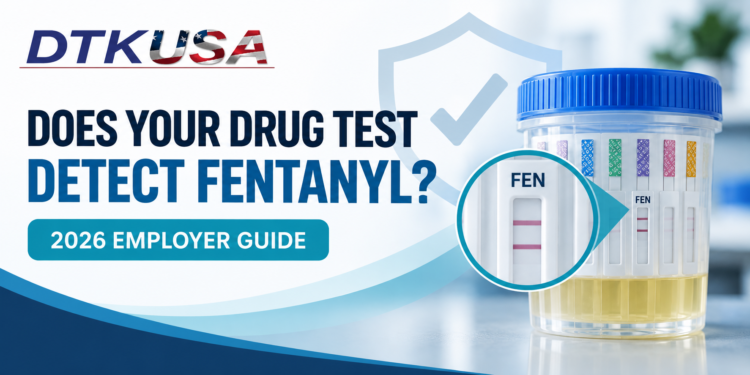
Many employers use what they consider a comprehensive drug-testing panel but may still have an important blind spot: fentanyl. A test may include an opiate

Security at Stripe: Learn how Stripe handles security.
A PCI-certified auditor has audited Stripe. We’re a certified PCI Service Provider Level 1. This is the most stringent level of certification available in the payments industry. To accomplish this, we use the best-in-class security tools and practices to maintain a high level of security at Stripe.
Stripe forces HTTPS for all services using TLS (SSL), including our public website and the Dashboard to ensure secure connections:
We regularly audit the details of our implementation, including the certificates we serve, the certificate authorities we use, and the ciphers we support. We use HSTS to ensure that browsers interact with Stripe only over HTTPS. Stripe is also on the HSTS preloaded lists for both Google Chrome and Mozilla Firefox.
All card numbers are encrypted at rest with AES-256. Decryption keys are stored on separate machines. None of Stripe’s internal servers and daemons can obtain plain text card numbers but can request that cards are sent to a service provider on a static allowlist. Stripe’s infrastructure for storing, decrypting, and transmitting card numbers runs in a separate hosting environment, and doesn’t share any credentials with Stripe’s primary services including our API and website.
Why use PayPal?
Your information is secured.
When you pay with PayPal, your financial information is never shared with the seller, and you can pay using only your email address and password.
Security around the clock.
PayPal monitors every transaction 24/7 to help prevent against fraud, email phishing and identity theft. Every transaction is heavily guarded behind their next-level encryption.
If something seems suspicious, their dedicated team of security specialists is immediately on it to help protect you from fraudulent transactions. And remember, PayPal will never ask for any sensitive information from you in an email.
You can be sure that your transaction is protected and secure when you use PayPal at the DrugTestKitUSA checkout.