

Blog
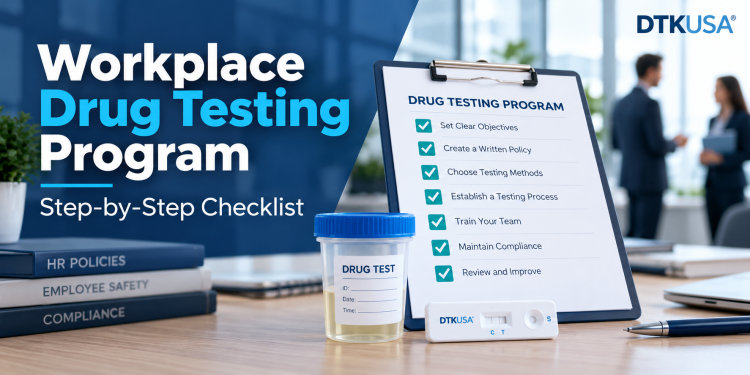
How to Start a Workplace Drug Testing Program: 8-Step Checklist
Maybe your insurance carrier asked about it. Maybe you had an incident on the floor. Or maybe you’re simply looking for a more consistent approach
How to Start a Workplace Drug Testing Program: 8-Step Checklist
Maybe your insurance carrier asked about it. Maybe you had an incident on the floor. Or maybe you’re simply looking for a more consistent approach to workplace safety and employee screening.
Whatever brought you here, you’re considering a workplace drug testing program, and you want to set it up correctly.
The good news is that the process is manageable when you approach it step by step. But the order matters. Choosing drug test kits before understanding your legal requirements, for example, can lead to unnecessary costs and compliance problems.
Whether you’re building a program for a small business or managing multiple locations, here’s how to get started.
Start here, because everything else depends on it.
If you employ commercial drivers, pilots, or other workers covered by federal transportation drug testing regulations, the Department of Transportation (DOT) establishes specific testing requirements.
DOT-regulated testing must follow 49 CFR Part 40 and the applicable transportation agency’s regulations. Employers cannot substitute rapid drug test cups or create their own testing procedures for federally mandated testing events.
Our DOT drug testing requirements guide explains the rules in more detail.
For employees who aren’t covered by DOT requirements, employers generally have more flexibility to establish their own testing programs. However, state and local laws, federal employment protections, and industry-specific requirements may still apply.
Some businesses need both types of programs.
For example, a trucking company may conduct federally mandated DOT testing for covered commercial drivers while maintaining a separate non-DOT policy for warehouse and administrative employees.
Keep these programs clearly separated. Different procedures, testing requirements, and documentation standards may apply.
The Drug-Free Workplace Act of 1988 requires certain federal contractors and grant recipients to maintain a drug-free workplace program.
However, the Act itself does not generally require employee drug testing.
Covered employers must meet requirements involving written policies, employee awareness, and other drug-free workplace measures. Additional testing obligations may apply under separate laws, contracts, or regulations.
State laws are one of the most important considerations when establishing a non-DOT workplace drug testing program.
There is no single set of state-independent rules that covers every private employer.
Depending on where your employees work, state or local laws may:
Maine: Employers generally must obtain approval of their substance use testing policy from the Maine Department of Labor before implementing a state-regulated testing program, subject to certain exceptions. The state also has specific employee-notice and testing procedures.
Learn more from the Maine Department of Labor.
Florida: Florida has a statutory drug-free workplace program with specific requirements for employers seeking the program’s benefits. For an employer establishing a new program under that framework, the law generally requires at least 60 days between the initial general employee notice and the beginning of testing.
Review the Florida Drug-Free Workplace Program statute.
If your business operates in multiple states, consider developing a core policy with state-specific addendums.
Have a qualified employment attorney review the policy before implementation, especially if you operate in states with different cannabis or employee privacy laws.
A written policy is the foundation of a consistent workplace drug testing program.
It establishes expectations for employees, gives supervisors a documented process to follow, and helps reduce inconsistent enforcement.
Your policy should clearly explain:
Write the policy in language employees can understand.
Before testing begins, distribute the policy, provide any legally required notice, and obtain signed employee acknowledgments when appropriate.
Remember that signing an acknowledgment does not replace any separate consent or authorization required by applicable law.
Once you’ve established your policy and legal requirements, it’s time to choose the testing products.
This is where employers sometimes make an expensive mistake: choosing a drug test based only on the number of panels or the price per cup.
A drug test panel represents a specific drug or drug class included in the screening process.
However, not every 6-panel or 12-panel drug test screens for the same substances.
Two products with identical panel counts may have different drug combinations, cutoff concentrations, or intended uses.
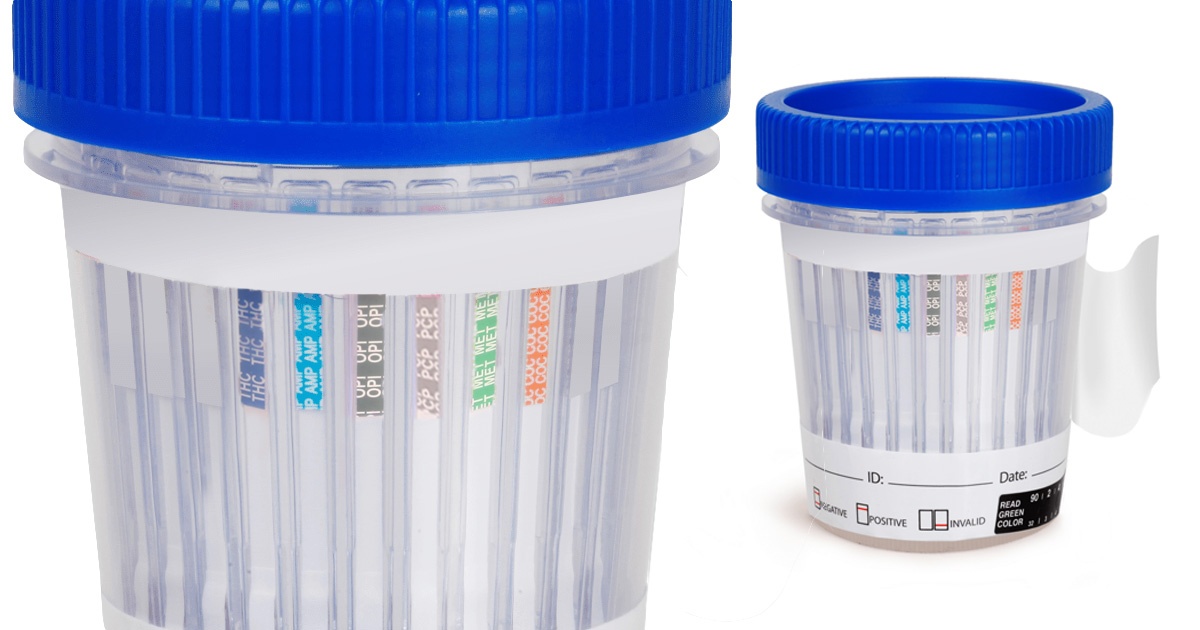
A 6-panel drug test screens for six substances or drug classes and may be suitable for certain non-DOT workplace screening programs.
A 12-panel drug test offers broader coverage and may include additional substances such as:
The exact combination varies by product.
Our 6-panel vs. 12-panel drug test cups guide explains the differences and important considerations when selecting a test.
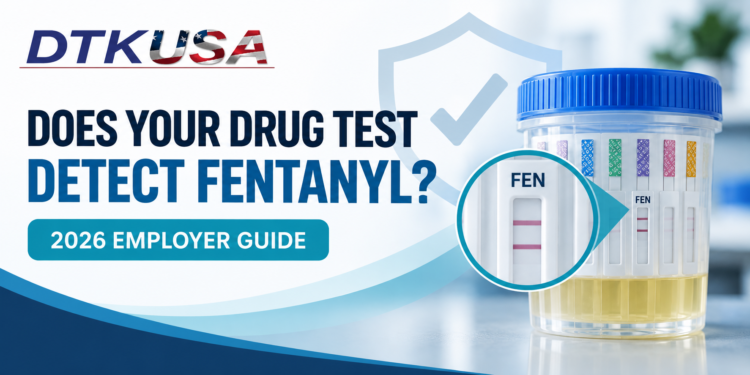
Don’t assume that a standard opiate panel detects fentanyl.
Many traditional opiate immunoassays primarily screen for morphine-related substances and do not reliably detect fentanyl.
If fentanyl screening is relevant to your program, look for a product that specifically includes a dedicated FEN panel.
Learn more in our fentanyl drug testing guide.
If specimen dilution or adulteration is a concern, consider urine drug test cups with built-in specimen-validity indicators.
Depending on the product, these may include:
These indicators provide additional information about specimen characteristics, but they do not independently prove that a sample has been tampered with.
All findings should be interpreted according to the product instructions and applicable testing procedures.
| Testing Option | When to Consider It |
|---|---|
| 6-panel drug test cups | When a focused selection of drug classes matches your non-DOT screening policy |
| 12-panel drug test cups | When your program requires broader substance coverage |
| Cups with specimen-validity indicators | When additional screening for certain specimen abnormalities is needed |
| Fentanyl-inclusive tests | When a dedicated fentanyl screen is part of your testing requirements |
Browse available drug test cups to compare panel configurations, specimen-validity features, and product specifications.
Not every workplace drug testing program is subject to the same CLIA requirements.
The Clinical Laboratory Improvement Amendments (CLIA) generally regulate laboratory testing performed for health assessment, diagnosis, prevention, or treatment.
Certain employment-related and forensic drug testing activities are exempt from CLIA requirements.
However, testing performed for medical purposes may be subject to CLIA, and requirements can depend on the testing setting, intended use, and applicable regulations.
Before purchasing, verify the product’s regulatory classification, intended use, labeling, and instructions.
If your testing is CLIA-regulated, confirm the appropriate laboratory certification requirements.
For additional information, review the CMS guidance on getting started with CLIA.
Rapid drug tests can provide convenient preliminary screening results, but they have limitations.
A non-negative result on a rapid screening test is not the same as a confirmed positive result.
Screening tests may react to certain substances or medications, and results must be interpreted according to the product instructions.
Before making employment decisions based on a presumptive positive result, employers should follow applicable requirements for laboratory confirmation and medical review.
When appropriate, a non-negative specimen is sent to a qualified laboratory for confirmatory testing using a more specific analytical method, such as:
These methods help identify specific substances and reduce the risk of acting on a false-positive screening result.
A Medical Review Officer (MRO) is a licensed physician who evaluates certain laboratory drug testing results and determines whether there is a legitimate medical explanation for a confirmed positive result.
For example, an MRO may review relevant prescription information when interpreting a laboratory finding.
MRO review is mandatory for DOT-regulated drug testing and may be required by other applicable programs or policies.
For non-DOT programs, employers should determine what review procedures are legally required or appropriate.
Many occupational health and laboratory testing providers offer access to MRO services.
Chain-of-custody documentation records how a specimen was collected, handled, transferred, and processed.
Proper documentation helps establish specimen integrity and supports the reliability of the testing process.
Set up your confirmation procedures before your first testing event, not after receiving a disputed result.
A written policy is only effective when the people responsible for enforcing it understand the procedures.
Supervisor training is particularly important for reasonable-suspicion testing.
Managers should know how to recognize and document specific, observable behaviors that may justify testing under the applicable policy and law.
Examples of observations may include:
Documentation should focus on facts rather than assumptions.
For example:
Instead of writing, “The employee seemed impaired,” document specific observations such as:
“Employee demonstrated slurred speech and unsteady walking during the 2:15 p.m. shift.”
These observations do not establish the cause of the behavior, but they can help support a properly documented reasonable-suspicion assessment.
Supervisors should also understand how to respond when an employee may be experiencing a medical emergency rather than a substance-related issue.
Train HR personnel on:
DOT-regulated supervisors must meet additional federal training requirements.
Once the legal review, policy, vendor arrangements, and training are complete, you’re ready to introduce the program.
Communicate clearly with employees before testing begins.
Explain:
Provide the required notices and allow time for any legally required review or acknowledgment procedures.
Inconsistent application can create legal and employee-relations problems.
If your written policy applies to a particular group of employees, follow the same standards for everyone covered unless a lawful distinction or accommodation applies.
For random testing, use an impartial, documented selection procedure where random testing is legally permitted.
Employees who use lawfully prescribed medications may have protections under the Americans with Disabilities Act (ADA) and other applicable laws.
Employers should have a confidential process for addressing disability-related accommodations and medical explanations.
Avoid asking supervisors to make medical judgments about prescription medications or drug test results.
If a third-party consumer reporting agency provides drug testing information as part of an employment screening report, the Fair Credit Reporting Act (FCRA) may apply.
Depending on the circumstances, employers may need to provide disclosures, obtain authorization, and follow required adverse-action procedures.
Work with your screening provider and legal counsel to identify the requirements applicable to your program.
Your responsibilities don’t end when the testing program launches.
Drug testing records contain sensitive information and should be handled carefully.
Store records securely, restrict access to authorized personnel, and keep medical information separate from general personnel files where required.
Retention periods vary depending on applicable federal, state, and industry regulations.
Establish a documented retention schedule instead of assuming that every record must be kept for the same period.
Drug testing requirements and workplace practices can change.
Schedule an annual review that includes:
Consider reviewing the policy sooner if your business expands into another state, adds new safety-sensitive roles, or makes significant changes to its testing procedures.
Not for every employer. Certain federally regulated transportation positions and other covered jobs have mandatory testing requirements. Other employers may establish voluntary drug testing programs, subject to applicable federal, state, and local laws.
Instant drug test cups may be appropriate for certain non-DOT workplace screening programs when permitted by law and consistent with the product’s intended use. However, rapid on-site drug test cups cannot replace the federally required laboratory testing process for DOT-mandated testing events.
A rapid test that produces a presumptive positive result generally requires appropriate follow-up before it is treated as a confirmed positive. Depending on the program, this may include laboratory confirmation, medical review, and compliance with applicable employee protections.
Employers should not treat preliminary screening results as conclusive evidence of drug use or current impairment.
There is no universal testing frequency for every workplace. Employers may conduct pre-employment, random, post-accident, reasonable-suspicion, or other authorized testing depending on their policies and applicable laws. DOT-regulated programs have specific testing requirements and minimum random-testing rates established by the relevant transportation agency.
Before launching, make sure you’ve completed the following:
Once your policy and testing requirements are established, selecting the right supplies becomes easier.
DrugTestKitUSA offers rapid drug screening products in multiple configurations, including 6-panel and 12-panel urine drug test cups, expanded-panel options, and products with specimen-validity indicators.
Not sure which product fits your workplace screening needs?
Consider the drug classes you need to screen for, your expected testing volume, and whether you need additional features such as fentanyl screening or specimen-validity indicators.
Or Contact the DrugTestKitUSA Team for help comparing available product configurations, quantities, and features.
Disclaimer: This article is provided for general informational purposes only and does not constitute legal or medical advice. Workplace drug testing requirements vary by jurisdiction, industry, testing purpose, and employer policy. Employers should consult qualified employment counsel and appropriate testing professionals before establishing or modifying a workplace drug testing program.
Maybe your insurance carrier asked about it. Maybe you had an incident on the floor. Or maybe you’re simply looking for a more consistent approach
Many employers use what they consider a comprehensive drug-testing panel but may still have an important blind spot: fentanyl. A test may include an opiate

Security at Stripe: Learn how Stripe handles security.
A PCI-certified auditor has audited Stripe. We’re a certified PCI Service Provider Level 1. This is the most stringent level of certification available in the payments industry. To accomplish this, we use the best-in-class security tools and practices to maintain a high level of security at Stripe.
Stripe forces HTTPS for all services using TLS (SSL), including our public website and the Dashboard to ensure secure connections:
We regularly audit the details of our implementation, including the certificates we serve, the certificate authorities we use, and the ciphers we support. We use HSTS to ensure that browsers interact with Stripe only over HTTPS. Stripe is also on the HSTS preloaded lists for both Google Chrome and Mozilla Firefox.
All card numbers are encrypted at rest with AES-256. Decryption keys are stored on separate machines. None of Stripe’s internal servers and daemons can obtain plain text card numbers but can request that cards are sent to a service provider on a static allowlist. Stripe’s infrastructure for storing, decrypting, and transmitting card numbers runs in a separate hosting environment, and doesn’t share any credentials with Stripe’s primary services including our API and website.
Why use PayPal?
Your information is secured.
When you pay with PayPal, your financial information is never shared with the seller, and you can pay using only your email address and password.
Security around the clock.
PayPal monitors every transaction 24/7 to help prevent against fraud, email phishing and identity theft. Every transaction is heavily guarded behind their next-level encryption.
If something seems suspicious, their dedicated team of security specialists is immediately on it to help protect you from fraudulent transactions. And remember, PayPal will never ask for any sensitive information from you in an email.
You can be sure that your transaction is protected and secure when you use PayPal at the DrugTestKitUSA checkout.