
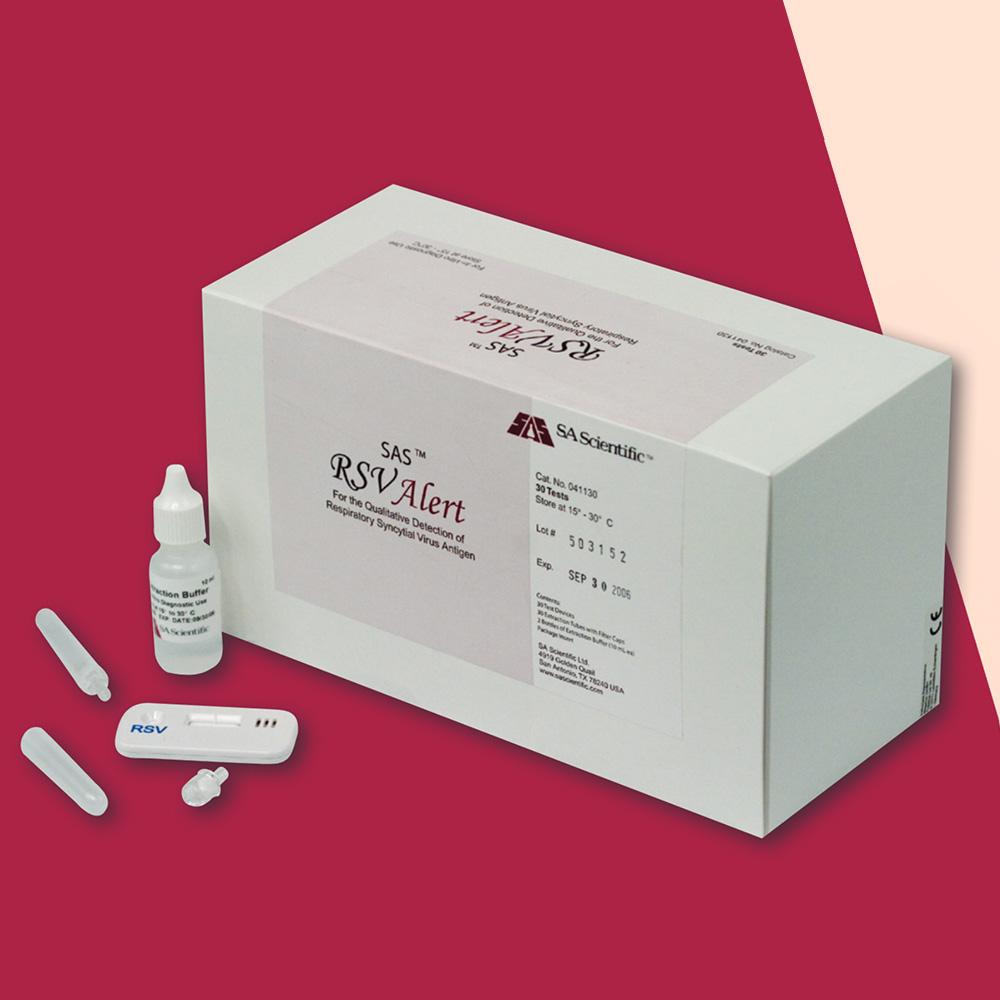
$310.00
30 tests per kit • $10.33 per test
The SA Scientific RSVAlert Test is a rapid visual assay for the qualitative detection of respiratory syncytial virus antigen in nasopharyngeal washes, aspirates and swab specimens from neonatal and pediatric patients. Results are read at 15 minutes.
| 1-5 | 6-10 | 11+ |
| $310.00 | $285.20 | $269.70 |
The SA Scientific RSVAlert Test is a rapid visual immunochromatographic assay for the qualitative detection of respiratory syncytial virus (RSV) antigen directly from nasopharyngeal specimens in neonatal and pediatric patients. Acceptable specimen types include nasopharyngeal washes, aspirates and swabs.
This professional in-vitro diagnostic test is FDA 510(k) cleared and listed as CLIA-waived. Results are read at 15 minutes, and each kit contains 30 tests.
| Specification | Details |
|---|---|
| Test method | Rapid visual immunochromatographic sandwich assay |
| Analyte | Respiratory syncytial virus antigen |
| Specimens | Nasopharyngeal washes, aspirates and swab specimens |
| Intended population | Neonatal and pediatric patients |
| Result time | Read at 15 minutes; do not interpret after 30 minutes |
| Manufacturer-listed performance | 97% sensitivity / 98% specificity |
| Regulatory status | FDA 510(k) cleared, K022845; CLIA-waived |
| Storage | 59-86°F (15-30°C) in sealed pouches; do not freeze |
| Manufacturer-listed shelf life | 18 months; always verify the expiration date on the kit |
| Package size | 30 tests per kit |
The 97% sensitivity and 98% specificity figures are the manufacturer’s summary specifications. The package insert reports results from several individual studies with different specimen sets and comparator methods. These figures do not guarantee the outcome of an individual test.
A timer, RSV positive and negative external controls, and a pipette with tips capable of measuring the required specimen volume are listed as required materials that are not provided with the kit. The manufacturer lists the RSV Control Set separately as catalog number 041101.
This summary does not replace the manufacturer instructions. Follow the current package insert and, when performing the test in a waived setting, the CLIA Instruction Card supplied for that procedure. Observe all specimen-collection, quality-control, safety, timing, interpretation and disposal requirements.
It qualitatively detects respiratory syncytial virus antigen directly in nasopharyngeal specimens. The test does not provide a quantitative viral-antigen measurement.
The package insert lists nasopharyngeal washes, aspirates and swab specimens. Each specimen type must be collected and prepared according to the applicable manufacturer procedure.
The package insert states that the test is intended to detect RSV antigen in nasopharyngeal specimens from neonatal and pediatric patients.
Yes. FDA’s CLIA database lists SAS RSVAlert as waived. The downloadable package insert is an older moderate-complexity version, so waived sites should follow the separate CLIA Instruction Card and current manufacturer requirements.
No OTC or home-use claim is made for this configuration. It is presented as a professional in-vitro diagnostic test for use according to the manufacturer’s instructions and applicable laboratory requirements.
Read the test at 15 minutes. A positive line may appear sooner when antigen levels are high, but all results should be read at the specified time and should not be interpreted after 30 minutes.
No. The insert lists RSV positive and negative controls as materials not provided. SA Scientific lists a separate RSV Control Set under catalog number 041101.
No. A negative result does not exclude RSV infection. Results should be evaluated with the patient’s clinical information, and the package insert recommends confirmation of negative results by cell culture.
Store the test devices at 59-86°F (15-30°C) in sealed pouches and do not freeze the test kit or reagents. Always verify the expiration date printed on the kit.
Review current CDC information about RSV laboratory testing, specimen considerations and the differences between antigen and molecular tests.
| Weight | 6 lbs |
|---|---|
| Dimensions | 10 × 10 × 5 in |

Security at Stripe: Learn how Stripe handles security.
A PCI-certified auditor has audited Stripe. We’re a certified PCI Service Provider Level 1. This is the most stringent level of certification available in the payments industry. To accomplish this, we use the best-in-class security tools and practices to maintain a high level of security at Stripe.
Stripe forces HTTPS for all services using TLS (SSL), including our public website and the Dashboard to ensure secure connections:
We regularly audit the details of our implementation, including the certificates we serve, the certificate authorities we use, and the ciphers we support. We use HSTS to ensure that browsers interact with Stripe only over HTTPS. Stripe is also on the HSTS preloaded lists for both Google Chrome and Mozilla Firefox.
All card numbers are encrypted at rest with AES-256. Decryption keys are stored on separate machines. None of Stripe’s internal servers and daemons can obtain plain text card numbers but can request that cards are sent to a service provider on a static allowlist. Stripe’s infrastructure for storing, decrypting, and transmitting card numbers runs in a separate hosting environment, and doesn’t share any credentials with Stripe’s primary services including our API and website.
Why use PayPal?
Your information is secured.
When you pay with PayPal, your financial information is never shared with the seller, and you can pay using only your email address and password.
Security around the clock.
PayPal monitors every transaction 24/7 to help prevent against fraud, email phishing and identity theft. Every transaction is heavily guarded behind their next-level encryption.
If something seems suspicious, their dedicated team of security specialists is immediately on it to help protect you from fraudulent transactions. And remember, PayPal will never ask for any sensitive information from you in an email.
You can be sure that your transaction is protected and secure when you use PayPal at the DrugTestKitUSA checkout.