
$52.00
25 strips per bottle • $2.08 per strip
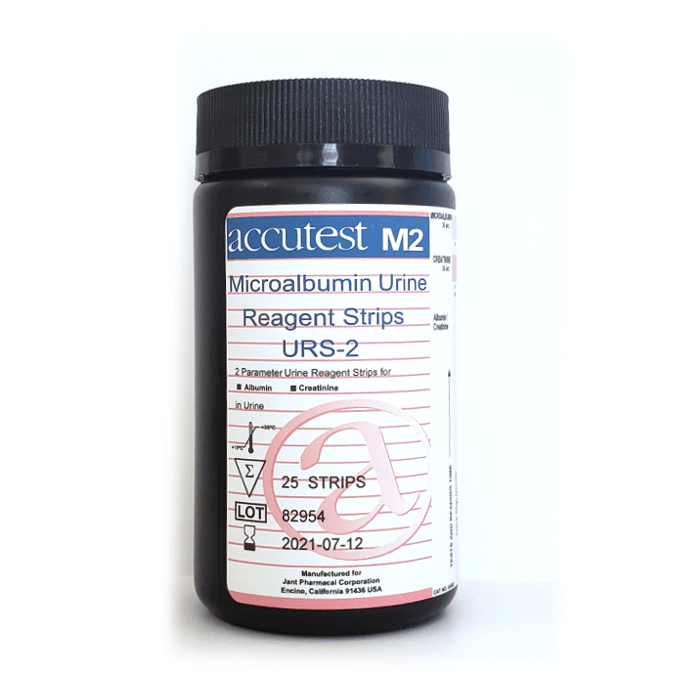
Accutest® M2 Microalbumin Urine Reagent Strips are CLIA-waived, visually read strips for the semi-quantitative determination of albumin and creatinine in urine. Measuring both analytes from the same random single-void urine specimen allows the albumin-to-creatinine ratio (ACR) to be determined, with results read at 30 seconds.
| 1-5 | 6-10 | 11+ |
| $52.00 | $47.84 | $45.24 |
Accutest® M2 Microalbumin Urine Reagent Strips are intended for the semi-quantitative determination of albumin and creatinine in urine. Each strip contains two reagent areas, allowing both measurements to be obtained from the same random single-void urine specimen and used to determine the albumin-to-creatinine ratio (ACR).
The strips are ready to use and are interpreted visually by comparing each reagent pad with the corresponding color blocks on the bottle label. The included ACR quick-reference table categorizes results from normal through high abnormal. This CLIA-waived configuration is for professional in vitro diagnostic use only and is not an over-the-counter self-test.
| Specification | Details |
|---|---|
| Test method | Visual color-comparison urine reagent strip |
| Determination | Semi-quantitative |
| Analytes | Albumin and creatinine |
| Specimen | Fresh, well-mixed human urine; random single-void specimens may be used to determine ACR |
| Format | Two reagent areas on one disposable strip |
| Read time | 30 seconds for albumin and creatinine |
| Albumin color blocks | 10, 30, 80 and 150 mg/L |
| Creatinine color blocks | 10, 50, 100, 200 and 300 mg/dL |
| ACR categories | Less than 30 mg/g: normal; 30-300 mg/g: abnormal; greater than 300 mg/g: high abnormal |
| Regulatory status | FDA 510(k) cleared; CLIA waived for visually read urine protein/albumin and creatinine testing |
| Intended user | Professional in vitro diagnostic use only; not for self-testing |
| Storage | 59-86°F (15-30°C), protected from direct sunlight, moisture and heat |
| Opened-bottle stability | Use within 3 months after first opening and never beyond the labeled expiration date |
| Package size | 25 single-use strips per bottle |
| CPT code listed by manufacturer | 82043QW |
This procedure summary does not replace the package insert or bottle color chart. Follow the complete manufacturer instructions and the timing printed on the current product label before testing or interpreting results.
| Measurement | Visual Result Range | Interpretation Guidance from the Insert |
|---|---|---|
| Albumin | 10, 30, 80 or 150 mg/L | Normal random-urine albumin is described as under 20 mg/L; the insert identifies 20-200 mg/L as microalbuminuria and values above 200 mg/L as clinical albuminuria. |
| Creatinine | 10, 50, 100, 200 or 300 mg/dL | The insert describes the expected random-urine range as 10-300 mg/dL. |
| ACR: Normal | Less than 30 mg albumin/g creatinine | Use the included ACR quick-reference table to determine the category from the paired albumin and creatinine readings. |
| ACR: Abnormal | 30-300 mg/g | An abnormal result requires appropriate clinical evaluation and confirmation. |
| ACR: High Abnormal | Greater than 300 mg/g | A high-abnormal result requires appropriate clinical evaluation and confirmation. |
The color blocks represent nominal values, and actual values may vary around them. This product provides a preliminary semi-quantitative screen. Definitive diagnostic or therapeutic decisions must not be based on a single test result or method, and abnormal results should be confirmed by a laboratory using an appropriate alternate method.
These percentages describe the specific manufacturer studies summarized in the package insert and are not a blanket accuracy guarantee. Visual interpretation, proper timing, specimen quality, storage and potential interferences can affect results.
Each strip provides semi-quantitative visual measurements for albumin and creatinine in urine. The paired readings allow the urine albumin-to-creatinine ratio to be determined.
Yes. The FDA CLIA database lists Jant Pharmacal Accutest M2 Microalbumin Urine Reagent Strips as waived for visually read urine protein/albumin and creatinine testing.
No. The package insert identifies the product for professional in vitro diagnostic use only.
The current product brochure specifies a 30-second read time for both the microalbumin and creatinine reagent areas. Always follow the timing printed on the current bottle label and package insert.
No. The reagent pads are read visually by comparing their colors directly with the corresponding blocks on the bottle label. The insert states that no instrument should be used to interpret the strips.
The manufacturer’s quick-reference table categorizes ACR results as normal below 30 mg/g, abnormal from 30-300 mg/g and high abnormal above 300 mg/g. Some albumin and creatinine combinations may not permit an ACR determination.
The package insert states that opened bottles should be used within 3 months after first opening. Keep the cap tightly closed, retain the desiccant and never use strips after the labeled expiration date.
Each bottle contains 25 single-use Accutest M2 Microalbumin Urine Reagent Strips and a desiccant. The package insert and ACR interpretation information accompany the product; controls and a urine specimen container are not supplied.
Browse additional urine reagent strips and rapid urinalysis products for professional point-of-care testing.
Review professional information from the National Institute of Diabetes and Digestive and Kidney Diseases about using spot urine albumin-to-creatinine ratio testing when evaluating kidney disease.
| Weight | 1 lbs |
|---|---|
| Dimensions | 2 × 6 × 2 in |

Security at Stripe: Learn how Stripe handles security.
A PCI-certified auditor has audited Stripe. We’re a certified PCI Service Provider Level 1. This is the most stringent level of certification available in the payments industry. To accomplish this, we use the best-in-class security tools and practices to maintain a high level of security at Stripe.
Stripe forces HTTPS for all services using TLS (SSL), including our public website and the Dashboard to ensure secure connections:
We regularly audit the details of our implementation, including the certificates we serve, the certificate authorities we use, and the ciphers we support. We use HSTS to ensure that browsers interact with Stripe only over HTTPS. Stripe is also on the HSTS preloaded lists for both Google Chrome and Mozilla Firefox.
All card numbers are encrypted at rest with AES-256. Decryption keys are stored on separate machines. None of Stripe’s internal servers and daemons can obtain plain text card numbers but can request that cards are sent to a service provider on a static allowlist. Stripe’s infrastructure for storing, decrypting, and transmitting card numbers runs in a separate hosting environment, and doesn’t share any credentials with Stripe’s primary services including our API and website.
Why use PayPal?
Your information is secured.
When you pay with PayPal, your financial information is never shared with the seller, and you can pay using only your email address and password.
Security around the clock.
PayPal monitors every transaction 24/7 to help prevent against fraud, email phishing and identity theft. Every transaction is heavily guarded behind their next-level encryption.
If something seems suspicious, their dedicated team of security specialists is immediately on it to help protect you from fraudulent transactions. And remember, PayPal will never ask for any sensitive information from you in an email.
You can be sure that your transaction is protected and secure when you use PayPal at the DrugTestKitUSA checkout.